
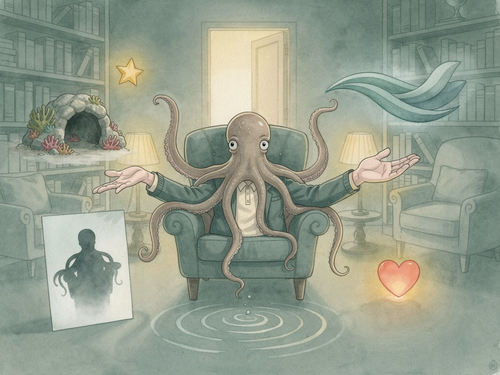

Richard Erskine’s eight relational needs offer language for some of the things people may seek, and struggle to seek, in close relationships: security, valuing, acceptance, mutuality, self-definition, making an impact, having the other initiate, and being able to express love.
The poem below advances a different, and potentially plausible interpretation. Eight needs, after all, are a remarkably convenient number for an octopus.
No claim is being made that Erskine had a beak, lived in a tank, or released ink when challenged in a seminar. That would be silly.
For a less aquatic introduction, read Understanding Erskine’s 8 Relational Needs: A Guide to Healthier Connections.
The Entirely Plausible Case That Richard Erskine Was an Octopus
Some say Erskine was an octopus.
At first, this sounds a little strained:
No ink-stained tank beside his desk,
No tentacle was ever named.
But pause. Eight relational needs:
Eight arms, arranged in tidy rows.
Coincidence? The thoughtful reader
Knows exactly where this goes.
One arm required security:
A sheltered cave, a steady reef;
A place where frightened, tender selves
Could loosen, slowly, from their grief.
One arm asked to be valued: proof
That feeling mattered, hope had weight;
“Your storm is not ridiculous.
I see it gathering at the gate.”
One arm reached for acceptance:
A strong, dependable other near;
Not one who fled when ink appeared,
Nor panicked at a tentacle’s tear.
One arm longed for mutuality:
“Do you know what this has been like?”
Not merely nodding from the shore,
But feeling something of the tide.
One arm insisted on self-definition:
“Do not decide what I must be.
I may be shy, eccentric, blue,
And still entirely, wholly me.”
One arm wanted to make impact:
“I moved your world; it changed a bit.
Please do not say you never noticed.
I was, in fact, a part of it.”
One arm wanted the other’s initiative:
“Come looking. Do not always wait.
A relationship cannot survive
If only I approach the gate.”
The final arm reached out with love:
Not neediness, nor trick, nor test;
But care that wished to give as well
As be received and warmly held.
Now count them: safety, being valued,
Acceptance, mutuality too;
The right to be oneself, make impact,
Be sought, and offer love to you.
Eight arms. Eight needs. The proof is sound.
No serious scholar could refuse:
Erskine was an octopus—
Or else he had remarkably good views.
Footnote
While this thesis is entirely plausible, I make no claims that it is inerrant. For a more orthodox interpretation of Erskine and his ideas, you can look to: Understanding Erskine’s 8 Relational Needs: A Guide to Healthier Connections.