
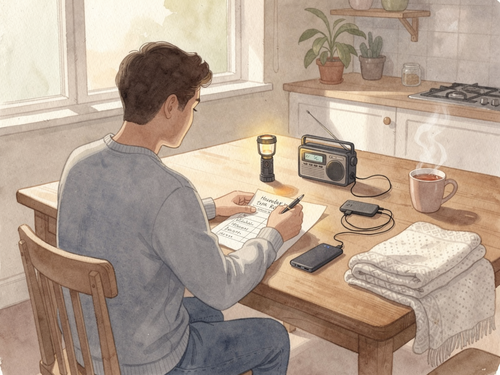

The government’s Be Ready campaign suggests building a modest three-day supply of essentials, making a household plan and staying connected with neighbours. It is explicit that people do not need to do everything at once, and that they can take the steps that work for them.[1]
Public advice about emergencies can be sensible and still land heavily. A request to think about power cuts, severe weather, disrupted travel or three days at home may touch a much larger fear: that the world is less dependable than we had hoped.
If that is happening for you, it does not mean you are overreacting or failing at resilience. Anxiety often tries to solve uncertainty by asking for more certainty than life can offer. Existential dread can do something similar, but on a larger scale: it can make ordinary vulnerability feel suddenly close and impossible to put down.
Preparation is not a test of whether you are sufficiently organised, self-reliant or alert. It is an invitation to make one small part of life a little easier to manage if things become difficult.
Let the advice be practical, not total
Anxious minds are very good at turning a short checklist into a vast private duty. We can begin with a torch and end up trying to foresee every possible disaster. The aim is not to become invulnerable. None of us can do that.
Instead, try asking:
What is one kind, proportionate thing I could do this week that would make a disruption slightly less difficult?
That might be checking whether you have a working torch, writing down an important telephone number, putting a little extra food you already eat in the cupboard, or agreeing with someone nearby how you might check in on each other. It might equally be deciding that you have done enough for now.
Small actions can give anxiety somewhere real to go. They are different from compulsive reassurance-seeking because they have a clear edge: you complete the task, notice that it is complete, and return to the rest of your life.
1% of a task done is better than 0%.
Notice when preparation becomes a way of feeding fear
Preparation becomes less helpful when it keeps expanding, when you cannot stop reading updates, or when every ordinary inconvenience starts to feel like evidence of catastrophe. It can also become difficult when your body is permanently on alert: tense, exhausted, unable to settle, or repeatedly pulled into imagined futures.
When this happens, it may help to make the task smaller rather than trying harder. Put a limit around it: ten minutes, one item, one conversation. Then do something that brings you back into the present: make a meal, take a walk, speak to someone you trust, listen to music, or attend to a familiar routine.
The NHS advises focusing on small achievable targets rather than trying to do everything at once, and suggests talking with someone you trust, movement, calming breathing exercises and support if anxiety is becoming hard to cope with.[3]
Existential dread needs companionship, not a perfect answer
Some fear is not really about the contents of a cupboard. It is about being reminded that we depend on systems, weather, other people and circumstances beyond our control. That can bring up questions about safety, mortality, climate, conflict, family and the future. These are not small questions, and they do not have neat answers.
You do not need to argue yourself out of every frightening thought. It can be more helpful to say: This is a big human feeling. I do not have to solve the whole future in this moment.
If you can, share the feeling with someone who will not rush to dismiss it. Talk at your own pace. A friend, family member, colleague, faith community or therapist may not be able to remove uncertainty, but being met in it can change the experience of carrying it alone.
The Be Ready guidance on coping after a traumatic event similarly points to talking with people you feel comfortable with, accepting emotional and practical support, doing something enjoyable and returning to everyday routines where you can.[2] Those ideas are not a cure for dread. They are ways of staying connected to the parts of life that are still here.
Make a plan that includes care
A useful emergency plan is not only a list of objects. It can include people and care:
- Who could I contact if I felt overwhelmed or isolated?
- Who might I check on, and who might check on me?
- What helps me come back to myself when I have been reading too much news?
- Which routines help me feel steady: food, sleep, movement, prayer, a familiar programme, time outside, medication, a morning cup of tea?
- What information do I actually need, and when will I stop looking for more today?
This is particularly important for people whose previous experiences have taught them that safety can disappear quickly. Preparedness messages can be activating. You are allowed to adapt them to your circumstances, take them slowly, ask for help with them, or step away and return later.
A gentle place to begin
If you would like to respond to the Be Ready advice without getting lost in it, try this:
- Look at what you already have.
- Choose one small, useful action.
- Tell one person what you are doing, or ask what would help them.
- Set a time to stop.
- Do something ordinary and grounding afterwards.
The point is not to prove that nothing bad will happen. The point is to meet uncertainty with a little more care, connection and practical kindness.
If anxiety, fear or panic is affecting your life or feels difficult to cope with, support is available through your GP, NHS Talking Therapies and other mental-health services. If you or someone else is in immediate danger, call 999.[3][1]
Sources
[1] — Be Ready: Be ready for emergencies [2] — Be Ready: Coping with trauma [3] — NHS: Get help with anxiety, fear or panic