
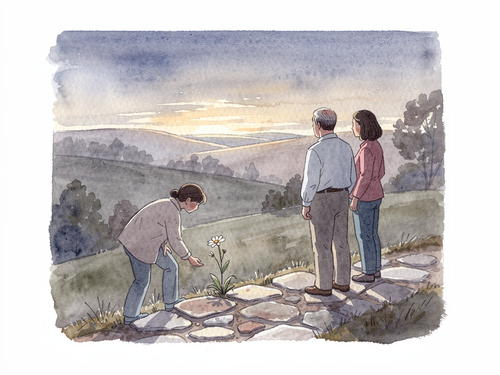

Gestalt therapy is often introduced through three closely connected foundations: phenomenology, field theory and dialogue. They are sometimes called its three pillars, though they are not three separate techniques to be applied in sequence. Together, they shape how a Gestalt practitioner understands experience, relationship and change.
This is also why Gestalt can be difficult to reduce to a list of interventions. The central question is not simply, “What technique will solve this problem?” It is, “What is happening here, now, for this person, in this situation, and between us?”
The names most often associated with Gestalt include Fritz Perls, Laura Perls, Paul Goodman and Ralph Hefferline. The approach also draws on the philosophy of Martin Buber and Maurice Merleau-Ponty, while later writers including Petruska Clarkson, Malcolm Parlett and Joseph Zinker developed and clarified its implications for practice.
1. Phenomenology: beginning with experience as it is lived
Phenomenology is the disciplined practice of attending to experience before rushing to explain it.
In a therapeutic conversation, this might mean noticing a tightening in the chest, a pause before a particular word, a sudden loss of eye contact, tears that arrive while someone says they are “fine”, or the difference between what is remembered and what is felt in the present. None of these observations is treated as a diagnosis in itself. They are invitations to curiosity.
This approach asks the therapist to hold their theories lightly. Rather than assuming that an event means one particular thing, they try to describe what is observable and check it with the client. “As you speak about your father, your voice has become quieter. What do you notice?” is a phenomenological question. It does not claim to know the answer in advance.
Maurice Merleau-Ponty’s phenomenology is important here because he described perception as embodied and situated. We do not encounter the world as detached minds collecting neutral information. We perceive through living bodies, shaped by movement, sensation, history and place. That emphasis helps explain why Gestalt pays attention not only to narrative, but also to breath, posture, gesture, rhythm, silence and the felt sense of a moment.
Laura Perls was particularly influential in keeping Gestalt close to lived, embodied experience. Her work resists the idea that therapy is merely an exchange of interpretations. Experience is not only something we report after the fact; it is something that is already unfolding in how we sit, speak, look, move and make contact.
Phenomenology does not mean that the past is unimportant. It means that the past is met through the way it becomes present now. A childhood memory, for example, may matter not only as a historical event but through the fear, loyalty, anger, numbness or longing that becomes perceptible in the current encounter.
2. Field theory: no person exists outside their situation
Field theory challenges the idea that psychological difficulty is located entirely inside an individual.
A person’s experience emerges within a field: their relationships, family history, culture, social position, work, money, health, environment, language, expectations and immediate circumstances. The field also includes what is happening between therapist and client in the room.
This does not mean that individual responsibility disappears. It means that responsibility is understood more accurately. A person may be trying to make a difficult decision while living with discrimination, financial pressure, caring responsibilities, trauma, neurodivergent overwhelm, an unsafe relationship or a workplace that is asking too much. To describe their distress as an isolated personal flaw would miss the conditions in which it is taking shape.
Malcolm Parlett developed field theory within contemporary Gestalt writing, especially through his account of the unified field. His emphasis is on the inseparability of person and situation: we do not first have a self-contained individual and then add context around them. What someone feels, notices, fears and can do is always shaped in relation to a changing world.
In practice, a field perspective broadens inquiry. Instead of asking only, “Why do you keep procrastinating?”, it may ask, “What becomes difficult at the point where this task needs to begin?” “Whose expectations are present?” “What support is available?” “What happens in your body when you imagine starting?” and “What in the wider situation makes this hard?”
This is not a way of avoiding personal agency. It is a way of making agency more realistic. Change is more possible when the field is seen clearly enough to identify both its constraints and its openings.
3. Dialogue: meeting another person rather than managing them
Dialogue gives Gestalt an ethical as well as a relational centre.
Martin Buber’s distinction between I–It and I–Thou has been especially important. An I–It relationship treats the other primarily as an object: something to assess, classify, fix, use or manage. An I–Thou relationship involves meeting another person as a subject with their own reality, difference and capacity to affect us.
In therapy, this does not mean abandoning professional boundaries or pretending that therapist and client have identical roles. The relationship remains structured by responsibility, confidentiality, consent and care. But a dialogic stance asks the therapist not to hide behind expertise. It invites genuine presence, careful responsiveness and a willingness to be changed by what is heard.
Dialogue is therefore more than warmth. It includes honesty, difference and the capacity to stay in contact when agreement is not immediate. A therapist may say, thoughtfully, “I notice I am uncertain whether I have understood you,” or “Something in what you have said has stayed with me.” Such responses are not disclosures for their own sake. Their value lies in whether they make the shared situation clearer and support the client’s own awareness.
Petruska Clarkson’s writing on Gestalt counselling offers a useful account of how theory becomes relational practice. It presents Gestalt not as a performance of dramatic techniques, but as a way of attending to contact, awareness, experiment and the quality of the therapeutic meeting.
Contact: where the three pillars meet
Contact is not always named as a fourth pillar, because it is better understood as what becomes possible through the three foundations together.
Contact happens at the boundary where a person meets something other than themselves: another person, a feeling, a memory, an opportunity, a limit or a difficult truth. In the foundational text Gestalt Therapy: Excitement and Growth in the Human Personality, Fritz Perls, Ralph Hefferline and Paul Goodman placed the contact boundary at the centre of their account of experience.
Phenomenology helps us notice what is happening at that boundary. Field theory helps us understand the conditions shaping it. Dialogue makes it possible to meet another person there with respect rather than control.
Contact is not fusion. Good contact includes difference. It allows someone to say yes, no, not yet, I do not know, I need more time, or this matters to me. It can also include withdrawal when withdrawal is needed. The question is not whether a person is always open, but whether they have enough awareness and support to choose how they come close, step back or respond.
Experiment: making room for something new
Joseph Zinker’s work is especially helpful in understanding why Gestalt uses experiment.
An experiment is not a trick and it is not a test that a client must pass. It is a carefully offered invitation to try something and notice what happens. A person who habitually says “I do not mind” might be invited to complete the sentence differently. Someone who speaks only from the head might be invited to notice their feet on the floor before continuing. A person who describes an inner critic might be invited to give it a voice, not because the therapist believes that voice is literally a separate person, but because hearing it differently may reveal its function and impact.
The purpose is not to produce a dramatic breakthrough on demand. It is to create conditions in which a different awareness or possibility can emerge. Sometimes the most useful experiment is very small: a pause, a change of pace, a new question, or the chance to notice that one has a choice.
A tradition, not a formula
Gestalt has never been a single, fixed system. Different writers and practitioners place different emphasis on embodiment, experiment, social context, existential philosophy, developmental theory and the therapeutic relationship. The three pillars are therefore best treated as orienting principles rather than a complete map.
They do, however, offer a useful discipline:
- Phenomenology: stay close to what is actually being experienced.
- Field theory: understand experience within its relational, social and material context.
- Dialogue: meet the other person as a person, not as a problem to be solved.
Held together, these principles offer a serious challenge to both reductionism and quick-fix therapy. They ask us to notice more carefully, locate distress more truthfully and take relationship seriously as a place where new possibilities can be discovered.
Related reading
- The Resnicks’ Model of Couples Therapy offers a concise summary of field theory, phenomenology and dialogue as an essential Gestalt tripod.
- Choosing the Right Psychotherapy Modality
References and further reading
- Buber, M. (1970). I and Thou (W. Kaufmann, Trans.). Scribner.
- Clarkson, P. and Cavicchia, S. (2013). Gestalt Counselling in Action (4th ed.). SAGE.
- Merleau-Ponty, M. (2012). Phenomenology of Perception (D. A. Landes, Trans.). Routledge.
- Parlett, M. (1997). “The Unified Field in Practice.” Gestalt Review, 1(1), 16–33.
- Perls, F., Hefferline, R. F. and Goodman, P. (1951). Gestalt Therapy: Excitement and Growth in the Human Personality. Julian Press.
- Perls, L. (1992). Living at the Boundary: The Collected Works of Laura Perls. The Gestalt Journal Press.
- Zinker, J. C. (1977). Creative Process in Gestalt Therapy. Brunner/Mazel.