
A common barrier to starting therapy is the thought: “Other people have it worse.” You may look at your life and decide that your distress is not dramatic enough, not traumatic enough, or not unusual enough to justify seeking help. This thought can be surprisingly...
Mental Health and Wellbeing Articles

Is My Problem Serious Enough for Therapy?

When Anger Is Trying to Protect Something Tender
Anger is often spoken about as if it is mainly a difficulty to be managed. We hear about anger management, anger issues, angry outbursts, angry people. Of course anger can become harmful. It can be used to intimidate, control, punish or avoid responsibility. When...

Polyamory in the Therapeutic Space
Holding Multiple Realities A client sits across from you and says, almost in passing, “my partners and I have been talking about…” She does not pause at the plural. She does not look up to check your face. The sentence just continues, because for her this is simply...
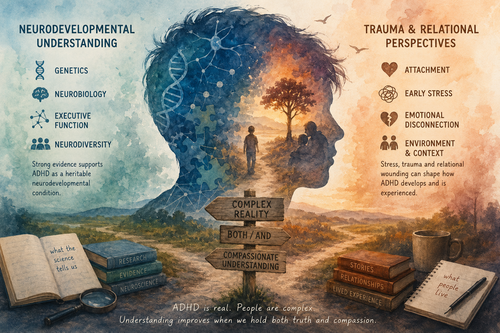
Concerns About Gabor Maté’s Teachings Among People with ADHD
Gabor Maté continues to have a strong influence on trauma-informed psychotherapy. His work on addiction, attachment, trauma, stress, and emotional development has resonated deeply with many people seeking alternatives to purely biomedical explanations of psychological...
A conversation with AI about The Ghost in the Machine
Introduction The phrase “ghost in the machine,” coined by Gilbert Ryle (1949), was intended as a critique of the idea that the mind is a separate, non-physical entity inhabiting the body. While this philosophical position might initially seem abstract, it has profound...

Selfobjects and Developmental Trauma: A Self Psychological Perspective
Developmental trauma is increasingly understood not only as the result of overwhelming events, but also as the consequence of chronic relational failures during early life. From a self psychological perspective, trauma arises when essential selfobject needs are...

How the Idea of Conscience in Human Beings is Reflected in the Structure of AI
I enjoy the use of analogies. For me they work not because of an exact correspondence, but the similarities and differences often help with an understanding of one or both sides of the analogy. In this, the result of a recent conversation with AI, I was able to learn...
Kohut’s Self Psychology and the Role of Selfobjects in Psychological Wellbeing
Heinz Kohut’s self psychology represents a significant shift within psychoanalytic thought, moving the focus from instinctual drives and conflict towards the development, cohesion, and maintenance of the self. This contrasts strongly with writers such as Jung and...

Eco-Anxiety and Climate Grief – How Psychotherapy Can Help in a Changing World
As the realities of climate change become increasingly difficult to ignore–increasing average global temperatures, increasing sea-level, more extreme weather–many people are experiencing profound emotional responses to environmental degradation, biodiversity loss, and...
To view the full article, just click on the article title (in dark blue.)