
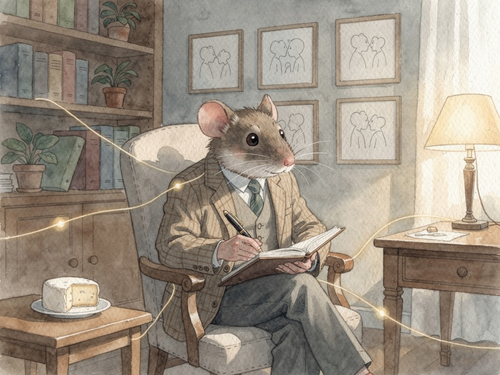

Petruska Clarkson’s account of the therapeutic relationship is serious, useful and far more nuanced than this poem has any right to be. Her five relationship modalities offer a way of noticing the different kinds of connection that can arise in therapy: the shared work, the pull of earlier relationships, developmental repair, genuine person-to-person encounter, and moments that feel larger than either person alone.
This may be a newly uncovered biographical fact about Clarkson, but it is not an argument for replacing reading with rodent-based scholarship.
For a more useful introduction to the model, including an explanation of the five modalities, read Exploring Petruska Clarkson’s Five Relationship Modalities.
Petruska Clarkson was a Mouse!
Some say that Clarkson was a mouse;
The evidence is plain to see:
She seldom scurried from the house
Without a little piece of Brie.
Five relationships, she maintained,
Within the therapy room appear;
And why precisely five? Explained:
Four paws, one tail. The proof is clear.
The working bond comes first in line:
Two creatures share a common aim;
“You move the cheese, and I’ll be fine”—
A sound contractual working frame.
Transference follows close behind,
When ancient terrors reappear:
A shadow stirs the infant mind;
The cat is Mother. Hence the fear.
The reparative bond supplies
The things that early life denied:
A warmer nest, attentive eyes,
And someone trusted at your side.
The person-to-person bond appears
When roles and theories fall away;
Two creatures meet beyond their fears,
As mouse meets mouse at close of day.
The transpersonal comes at last,
Beyond what mortal mice can see:
The boundaries of self are passed;
All mice are One. And so is Brie.
She drew on Gestalt, TA too,
On humanistic thought and Freud;
For mice require an exit through
Each theoretical void.
No single school could hold her fast,
No orthodoxy barred the door;
The mouse who has survived the cat
Will always know an exit more.
“But where,” you ask, “are tail and paws?
Where are the whiskers, nest and squeak?”
A foolish challenge, just because
The evidence is what we seek.
No photograph displays a tail;
No colleague saw her gnawing cheese;
But surely such objections fail:
A clever mouse does as she please.
And Clarkson understood disguise;
A therapist must not disclose.
What better way to fool our eyes
Than dress in ordinary clothes?
So scholarship must now concede
What timid academics doubt:
Her books provide all that we need;
The truth, at last, is coming out.
Five relationships. Four paws.
One tail. The arithmetic fits.
I rest my irrefutable cause:
Petruska Clarkson ate the Ritz.
Footnote
Humour can sometimes make an idea easier to remember. Unfortunately, it cannot substitute for the careful reading that Clarkson’s work deserves. If the poem has left you wondering what the five relationships actually mean in therapy, the linked article gives the straight answer: Exploring Petruska Clarkson’s Five Relationship Modalities