
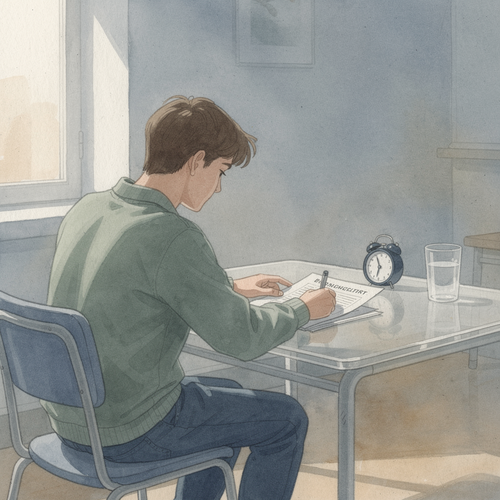

When exam anxiety rises, the difficulty is rarely only the questions on the paper. The whole occasion can arrive at once: the room, the clock, the sense of being judged, memories of previous results, worries about disappointing someone, and the frightening thought that one poor performance might determine too much. Under that pressure, an exam can feel less like a sequence of answerable tasks and more like a single, unmanageable threat.
One useful response is to make the task smaller. Not because anxiety is irrational, or because a timer can solve the wider pressures around assessment, but because attention often works better when it has a nearer horizon. Rather than repeatedly asking, “Can I get through this exam?”, it may help to ask, “What is the next fifteen minutes asking of me?”
This is related to the logic of the Pomodoro technique: working in a defined period, then pausing before beginning again. In an exam, however, it needs adapting carefully. You may not be able to stop work, leave the room, use a device, or take a formal break whenever you choose. The aim is not to create unofficial breaks or to ignore the exam rules. It is to divide the paper mentally into manageable phases, with very brief, permitted moments of reset.
Why a smaller time frame can help
Anxiety narrows attention, but it does not always narrow it helpfully. Some people become caught on one difficult question; others scan the whole paper and feel overwhelmed before they have begun. A fifteen-minute frame offers a modest boundary around the next task. It can turn “I have two hours to prove myself” into “For the next fifteen minutes, I will read this question, make a brief plan, and write what I can.”
The length is not sacred. Fifteen minutes may suit one person; ten, twenty or thirty may suit another, depending on the paper and the kind of thinking required. The value lies in having an agreed unit of attention before the anxiety becomes too loud.
This approach is best practised during revision, not introduced for the first time in the examination room. A student might rehearse answering one past-paper question in a short timed block, then pause to notice what helped and what got in the way. Over time, the structure becomes more familiar: begin, focus on one defined task, pause briefly, and choose the next step.
A simple way to structure the paper
Before the exam, look at the rules and the paper format. Then make a flexible plan rather than a rigid one. For example:
- Spend the opening few minutes reading the instructions and marking the questions you can begin.
- Work in short blocks: one question, one section, or roughly fifteen minutes of purposeful work.
- At the end of each block, take a few seconds to check where you are, sip water if permitted, relax your shoulders, and decide on the next task.
- Leave a small amount of time at the end to review answers, rather than treating every minute as a test of endurance.
The plan should remain adjustable. A difficult calculation, an essay plan, or a practical task will not always fit neatly into a quarter-hour. The purpose is not to obey the timer perfectly. It is to have a way back when panic, perfectionism or blankness threatens to take over.
A useful internal phrase might be: “I do not need to complete the whole exam now. I need to stay with this next piece.” This is not positive thinking in the sense of insisting that everything will be fine. It is a practical way of returning from a frightening imagined future to the work that is actually available in the present.
Brief resets: mindfulness without making it another test
A reset does not need to be a formal meditation. In an exam, it may be only ten seconds. You might feel your feet against the floor, notice the weight of the pen in your hand, let out a slightly longer out-breath, or name three neutral things you can see. The point is not to empty the mind or eradicate nervousness. It is to widen attention enough to choose what comes next.
Some people find it helpful to acknowledge the anxiety directly: “My body is alarmed; I can still read the next line.” Research on how people interpret stress suggests that viewing arousal as a response that can support effort, rather than as proof of impending failure, may be helpful in evaluative situations. That will not suit everyone, and it should not become another demand to feel the “right” way. It is simply one possible alternative to fighting every physical sign of nerves.
If mindfulness makes you feel more self-conscious, overwhelmed or detached, choose something plainer. Regulation should serve the task, not become a performance in itself.
Neurodivergence, distraction and sensory regulation
For some neurodivergent students, turning inwards towards breath or bodily sensation is not the most regulating option. It may increase sensory awareness at the wrong moment, feel painfully effortful, or simply not hold attention. A brief, structured form of external focus can be more useful: tracing the edge of a permitted object with a finger, looking at a neutral point in the room, silently naming categories such as colours or shapes, or using a familiar grounding phrase.
It is worth distinguishing between a brief regulation strategy and an attempt to escape the exam altogether. A good reset is short, predictable and helps you return to the next question. It does not need to look calm from the outside to be effective. Some people may need a discreet movement, a sip of water, a change of posture, or a moment of visual rest.
Where sensory needs, ADHD, autism, panic, chronic illness or another disability significantly affect access to examinations, support should not depend solely on personal coping techniques. Speak with the school, college, university or awarding body well in advance about the adjustments available and the evidence they require. Rest breaks, extra time, a smaller room or other arrangements may be possible, but the rules and eligibility vary. Any strategy used in the room should be compatible with the agreed arrangements and the examination regulations.
When the method can become unhelpful
Breaking an exam into chunks is not a cure for exam anxiety, nor a substitute for revision, rest, accessible teaching or appropriate adjustments. It may be less helpful if the timer becomes another critic: “I have wasted three minutes”; “I should be further ahead”; “Everyone else is coping better.” In that case, the structure needs softening. A block can be a guide rather than a verdict.
It can also help to practise with compassion for the part of you that is frightened. Exam nerves often make sense in context. They may be connected with high expectations, experiences of criticism, a history of struggling in school, discrimination, financial pressure, or the understandable wish to secure a future. The task is not to shame that alarmed part into silence. It is to give it enough steadiness that you can continue.
A practice, not a promise
The most helpful version of this approach is usually smaller. During revision, try one or two short cycles with a past paper. Notice what length of focus is realistic, what kind of reset genuinely returns you to the task, and what makes things worse. Keep what helps; discard what does not.
On the day, the aim is not to feel perfectly composed. It is to make the next workable choice: read the instruction, answer the question in front of you, pause briefly when permitted, and begin again. An exam may still matter deeply. But it does not have to be held in the mind all at once.
Related reading
Using the Pomodoro Technique to Alleviate Pain explores the original idea of using a gentler rhythm of focus and pause when a task feels physically difficult.
Understanding the Window of Tolerance in Trauma Therapy offers a fuller account of why very high or very low arousal can make thinking and choice harder.
Who Is Jon Kabat-Zinn and What Is His Contribution to Mindfulness? introduces mindfulness as a way of relating to present experience, rather than a demand to make difficult feelings disappear.
References
Jamieson, J.P., Mendes, W.B., Blackstock, E. and Schmader, T. (2010) ‘Turning the knots in your stomach into bows: Reappraising arousal improves performance on the GRE’, Journal of Experimental Social Psychology, 46(1), pp. 208–212. Available at: https://doi.org/10.1016/j.jesp.2009.08.015.
Priebe, N.P. and Kurtz-Costes, B.E. (2022) ‘The effect of mindfulness programs on collegiate test anxiety’, Mindfulness, 13(11), pp. 2868–2878. Available at: https://doi.org/10.1007/s12671-022-02002-6.