
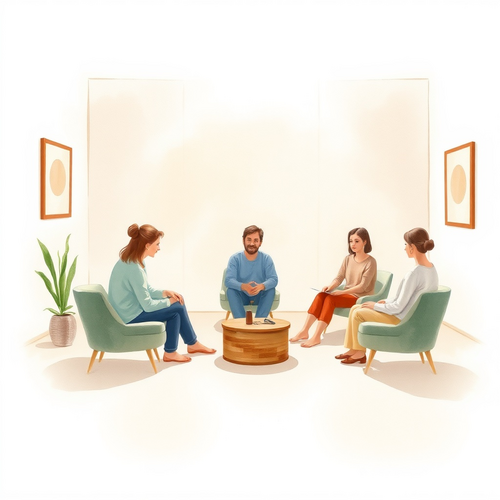

Donald Kalsched did not write a manual for therapeutic group work. His contribution is more indirect, and perhaps more clinically interesting. His writing gives psychotherapists a way of thinking about trauma, dissociation, archetypal defence and the inner protective systems that may be activated when vulnerable parts of the self come close to relationship.
For group therapists, this matters because a therapy group is rarely only a place where people talk about relationships. It is a place where relational worlds are re-created, defended against, projected, tested and sometimes transformed. The group member who withdraws after receiving care, attacks just as contact deepens, rescues others before attending to themselves, or dissociates when the group becomes emotionally alive may not simply be resisting the work. A protective inner system may have entered the room.
Kalsched’s two central books for this discussion are The Inner World of Trauma: Archetypal Defences of the Personal Spirit and Trauma and the Soul: A Psycho-Spiritual Approach to Human Development and Its Interruption. These texts are not group analytic texts in the usual sense. They are not concerned with technique, group stages or leadership styles. They are concerned with how the traumatised psyche protects something vulnerable, alive and easily injured. Read alongside group psychotherapy, they offer a depth psychological account of why contact can be both longed for and feared.
Trauma and the self-care system
One of Kalsched’s most useful clinical ideas is that trauma may generate a self-care system. This system protects the vulnerable core of the person from further injury. It may keep intolerable affect at a distance, split off dependency needs, attack hope, or prevent the person from trusting another mind.
The difficulty is that this protective system can become persecutory. What once preserved psychic survival may later attack the very possibilities that therapy offers: intimacy, mourning, desire, dependency, play, ordinary need, and the risk of being known.
In individual therapy this may appear as self-attack, idealisation, suspicion, withdrawal, dissociation, compliance, omnipotent control or a sudden collapse in reflective capacity. In group therapy the same processes may become distributed through the group field. One member may carry fragility, another attack, another rescue, another intellectual distance, another mute despair. The group then begins to embody aspects of the internal trauma system.
For the psychotherapist, the central question becomes less, “How do we remove this resistance?” and more, “What is this defence protecting, and how is the group now organised around it?”
The group as an amplifier of vulnerability
Therapeutic groups intensify relational experience. They offer multiple witnesses, multiple transferences, and multiple forms of recognition and misrecognition. A comment from one member, a silence from another, or a facial expression from the facilitator may evoke meanings far beyond the immediate event.
For some members, the group can be experienced as a potential community. For others, it may quickly become an internal theatre of exposure, shame, rivalry, abandonment or threat. The member may know intellectually that this is a therapy group, while another part of them experiences the room as a family, a school playground, a hostile tribunal, a rejecting peer group, or a dangerous dependency situation.
Kalsched helps us respect the intensity of such reactions. He invites us to consider that defences may have developed around parts of the self that had no adequate relational protection. When a therapy group comes close to those parts, the response may be sudden and disproportionate because it belongs not only to the present but to a much older organisation of survival.
Archetypal defence and group roles
In The Inner World of Trauma, Kalsched describes inner defensive figures that may protect the personal spirit by severe means. These figures may appear in dreams, fantasies, symptoms, inner voices, relational enactments and self-attacking states. In a group, the same defensive structures may become interpersonal roles.
A member may be unconsciously positioned as the dangerous one, the needy one, the rescuer, the fragile one, the envied one, the excluded one, or the one who must not be challenged. These roles are not fixed identities. They are field positions that may carry split-off affect for the individual and for the group.
This has practical implications. If a group member repeatedly becomes the focus of irritation, it is worth asking what the group is asking that member to carry. If another member becomes the consistent rescuer, it may be important to wonder what vulnerability is being avoided elsewhere. If the group idealises the facilitator, the therapist might listen for disowned aggression, longing, dependency or fear of collapse.
Kalsched’s work does not replace group analytic thinking, but it deepens it. It reminds us that some group roles are not merely social positions. They may be animated by powerful internal figures organised around trauma.
The paradox of care
A particularly useful Kalschedian theme for group therapists is the danger of care. Psychotherapists may assume that warmth, attunement and empathic response will be welcomed, or at least gradually internalised. With traumatised self-care systems, this is not always so.
Care can be threatening because it touches the part of the self that still longs. It may expose dependency, grief, envy, need or hope. For a member whose history has made hope dangerous, kindness may be followed by disappearance, sarcasm, intellectualisation, eroticisation, attack or numbing.
In a group this can be confusing. Other members may feel rejected or punished for caring. The facilitator may feel pulled to explain, reassure, interpret or rescue. A Kalsched-informed stance allows for more patience. The task is not to force the member to accept care, nor to allow their defence to dominate the group unexamined. It is to help the group notice what happens at the edge of contact.
The clinically useful intervention may be tentative and phenomenological: “Something seemed to change just after the group responded warmly to you. I wonder what it was like to receive that much attention.” Such an intervention does not shame the defence, but it invites curiosity about its timing and purpose.
Dissociation and the loss of symbolic space
Kalsched’s work is also helpful when thinking about dissociation in groups. A member may appear present but become internally absent. They may lose the thread, become vague, smile incongruently, over-explain, or report feeling unreal. The group may respond by moving around the dissociation, becoming anxious, filling the space, or treating the person as unreachable.
From a Kalschedian perspective, dissociation may be a protective withdrawal from unbearable affect or relational danger. It may be the psyche’s way of preserving a vulnerable centre when the interpersonal field becomes too charged.
The group therapist’s task is therefore not simply to interpret dissociation, but to help restore symbolic and relational space. This may involve slowing the group down, naming the shift gently, grounding the member in the present, and attending to the group response. The facilitator may need to hold both the individual and the group field: what happened for this member, and what happened in the room when they disappeared?
Trauma and the Soul
In Trauma and the Soul, Kalsched develops his earlier work in a more explicitly psycho-spiritual direction. He writes about trauma as an interruption not only of psychological development, but of aliveness, meaning and connection with the deeper self.
For therapeutic groups, this is significant. Group therapy is not only a site of symptom reduction or interpersonal learning. At its best, it can become a place where vitality returns. A member may discover that they can speak and still belong, disagree and still remain connected, feel shame without being expelled, or need others without losing dignity.
These moments may sound simple, but for traumatised members they can be profound. They may also be frightening. The return of aliveness can threaten the very defences that were built to preserve psychic survival. A group may therefore need to bear the rhythm of approach and retreat, rather than treating retreat as failure.
Implications for group psychotherapists
A Kalsched-informed approach to therapeutic groups would not mean imposing Jungian language on members, nor interpreting every event symbolically. It would mean cultivating a disciplined curiosity about the protective function of defences and the way inner trauma systems are enacted in the group field.
Several clinical attitudes follow.
First, defences should be approached with respect. They may be costly, but they are not meaningless. They often carry the history of survival.
Second, the therapist needs to attend to pacing. Too much emotional contact too quickly may activate severe protective responses. Equally, too much caution may collude with isolation.
Third, group roles should be understood as both personal and systemic. A member’s behaviour may express their history, but it may also carry something for the group.
Fourth, the facilitator must monitor their own countertransference. Traumatised self-care systems may pull the therapist into rescuing, confronting, withdrawing, idealising, over-structuring or becoming anxiously careful.
Finally, the group needs help to remain reflective when trauma defences enter the room. The therapeutic task is not to defeat the defence, but to create conditions in which the vulnerable self no longer has to be protected by such absolute means.
Limits and cautions
Kalsched’s work is evocative and clinically rich, but it requires careful use. Archetypal and psycho-spiritual language can illuminate experience, but it can also become too abstract or too interpretive if used without restraint. In group work, meanings need to be negotiated in the room, not imposed by the therapist’s theoretical enthusiasm.
It is also important not to psychologise all group conflict as trauma defence. Groups are social fields shaped by power, culture, race, class, gender, sexuality, neurodivergence, disability, authority and institutional context. Kalsched’s work helps us listen to inner protective systems, but it does not remove the need to attend to real interpersonal and social dynamics.
The most useful reading of Kalsched for group therapists is therefore integrative. His ideas sit alongside group analytic, relational, attachment-informed, trauma-informed and socially aware perspectives. They add depth, but they do not stand alone.
Conclusion
Kalsched offers psychotherapists a language for the hidden drama of trauma: the vulnerable self, the protective system, the persecutory defence, and the longing for contact that may be defended against as dangerous. In therapeutic groups, these dynamics may become visible not only in individual narratives, but in silences, roles, enactments, ruptures and sudden shifts in the emotional field.
His work reminds us that the person who resists care may also long for it; that the member who attacks may be protecting something fragile; and that the group itself may become a stage on which inner trauma systems seek recognition.
For group psychotherapists, this is a demanding but humane perspective. It asks us to hold the defence without shaming it, to protect the group without persecuting the individual, and to make room for the possibility that beneath even severe protective systems there may be a part of the self still waiting for a safer form of relationship.
References
Kalsched, D. (1996) The Inner World of Trauma: Archetypal Defences of the Personal Spirit. London: Routledge. Available at: https://doi.org/10.4324/9781315788081
Kalsched, D. (2013) Trauma and the Soul: A Psycho-Spiritual Approach to Human Development and Its Interruption. London: Routledge.