

Gabor Maté continues to have a strong influence on trauma-informed psychotherapy. His work on addiction, attachment, trauma, stress, and emotional development has resonated deeply with many people seeking alternatives to purely biomedical explanations of psychological distress.
At the same time, aspects of his teaching about ADHD have generated substantial debate, including among people diagnosed with ADHD, clinicians specialising in neurodevelopmental conditions, and researchers working within psychiatry and neuroscience.
This article explores some of the concerns commonly raised within ADHD communities regarding Maté’s approach, while also acknowledging why many people continue to find parts of his work meaningful and clinically useful.
Gabor Maté’s View of ADHD
Maté has argued that ADHD should primarily be understood as a developmental response to early stress, attachment disruption, emotional disconnection, and environmental pressures rather than as a condition determined predominantly by genetics.
In his writing and interviews, he has suggested that ADHD emerges through disruptions in emotional attunement and stress regulation during development. This places his work within a strongly relational and trauma-informed framework.
For some readers, this perspective offers a compassionate alternative to models that reduce ADHD to deficits, pathology, or brain chemistry alone. However, for others, this framing raises significant concerns.
Concern 1: Tension with Current Scientific Consensus
One of the most common criticisms is that Maté’s explanation appears to conflict with the broader scientific consensus regarding ADHD.
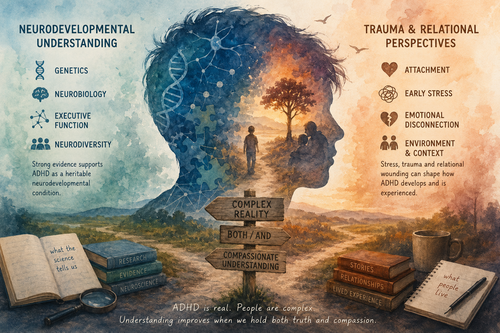
Current research generally understands ADHD as a neurodevelopmental condition with substantial heritability. Twin studies, family studies, and genome-wide association studies consistently suggest strong genetic contributions to ADHD development (Faraone & Larsson, 2019).
This does not mean environment is irrelevant. Environmental stress, adversity, trauma, sleep disruption, education systems, family relationships, and social context all affect how ADHD is expressed and experienced. However, critics argue that Maté sometimes presents trauma-based explanations with greater certainty than the evidence currently supports.
For some ADHD researchers and advocates, this creates concern that developmental trauma is being positioned not as one important factor among many, but as the central causal explanation.
Concern 2: Risk of Shame and Parental Blame
Many people with ADHD report emotional discomfort with the implication that ADHD primarily emerges from relational disruption or insufficient attunement during childhood.
Some interpret this framing as indirectly suggesting:
- that their parents caused their ADHD;
- that they were psychologically damaged into becoming neurodivergent;
- that healthier parenting could have prevented the condition;
- or that enough therapeutic healing might eliminate ADHD entirely.
For parents of ADHD children, these ideas can provoke intense guilt and self-blame. For adults with ADHD who do not identify with significant childhood trauma, the model may feel invalidating or overly reductive.
This issue becomes especially sensitive because many people with ADHD already carry histories of shame, criticism, exclusion, and chronic feelings of inadequacy. Some therefore experience trauma-centred explanations as adding another layer of implied defectiveness.
Concern 3: Blurring Trauma and Neurodevelopment
Trauma and ADHD can overlap in clinically significant ways.
Both may involve:
- attentional difficulties;
- emotional dysregulation;
- impulsivity;
- executive functioning problems;
- nervous-system hyperarousal;
- dissociation;
- difficulties with self-organisation.
Complex trauma may sometimes resemble ADHD, and ADHD itself may increase vulnerability to traumatic experiences through repeated failure, social rejection, overwhelm, or relational conflict.
Critics of Maté’s approach often argue that these overlaps do not necessarily mean ADHD is fundamentally caused by trauma. Instead, they suggest that trauma and neurodevelopmental differences can coexist and mutually amplify one another.
Many contemporary clinicians therefore favour a “both/and” framework:
- ADHD may be neurodevelopmental and substantially inherited;
- trauma may shape how ADHD is expressed;
- and living with ADHD may itself produce traumatic experiences over time.
This integrative position attempts to preserve the importance of attachment and emotional development without collapsing ADHD entirely into trauma theory.
Concern 4: Public Misunderstanding of ADHD
Another concern is the broader social impact of trauma-centred explanations.
People with ADHD often encounter scepticism from employers, educators, family members, and even healthcare professionals. Common misconceptions include:
- “ADHD is not real.”
- “Everyone struggles with concentration.”
- “It is caused by bad parenting.”
- “People just need more discipline.”
- “Medication is unnecessary.”
Some ADHD advocates worry that simplified interpretations of Maté’s teachings may unintentionally reinforce these dismissive narratives.
In public discourse, nuanced discussions about attachment and development can easily become oversimplified into claims such as: “ADHD is just trauma.”
For people who fought for years to receive diagnosis, support, accommodations, or medication, this can feel threatening and invalidating.
Why Some People Still Value His Work
Despite these criticisms, many people with ADHD continue to appreciate aspects of Maté’s work.
His writing often resonates because it:
- addresses shame compassionately;
- explores emotional suffering rather than only symptoms;
- validates the impact of chronic stress and relational injury;
- challenges purely deficit-based models;
- emphasises attunement and nervous-system regulation;
- acknowledges the social and cultural dimensions of distress.
Many clinicians also recognise that trauma-informed practice can be extremely valuable when working with ADHD clients, particularly where there are histories of neglect, bullying, rejection, emotional invalidation, or developmental trauma.
Importantly, recognising trauma does not require rejecting neurodevelopmental understandings of ADHD.
Towards a More Integrative Understanding
Increasingly, many practitioners and researchers advocate for integrative models that hold multiple perspectives simultaneously.
Within this view:
- ADHD is understood as a real neurodevelopmental condition;
- genetics contribute substantially;
- environmental experiences shape expression and adaptation;
- attachment and trauma may intensify difficulties;
- and therapeutic work may still significantly improve quality of life, regulation, and self-understanding.
This avoids framing ADHD as either “pure biology” or “pure trauma”.
Instead, it recognises that human development emerges through continuous interaction between biology, relationships, nervous systems, culture, stress, and lived experience.
Conclusion
The debate surrounding Gabor Maté’s teachings on ADHD reflects broader tensions within psychotherapy, psychiatry, and mental health culture.
For some people, his work offers a deeply humane corrective to reductionist understandings of distress. For others, aspects of his ADHD model feel scientifically unsupported, overly trauma-centric, or potentially shaming.
The discussion is unlikely to disappear because it touches on fundamental questions:
- What causes psychological suffering?
- How should we understand neurodiversity?
- What role do attachment and trauma play in development?
- And how can clinicians avoid both biological reductionism and trauma reductionism?
Perhaps the most clinically useful position is one that remains open to complexity — recognising the reality of neurodevelopmental difference while also taking relational experience and emotional suffering seriously.
References
Faraone, S. V. and Larsson, H. (2019) ‘Genetics of attention deficit hyperactivity disorder’, Molecular Psychiatry, 24(4), pp. 562–575. Available at: https://doi.org/10.1038/s41380-018-0070-0
Maté, G. (2023) Scattered Minds: The Origins and Healing of Attention Deficit Disorder. Revised edn. London: Vermilion. ISBN: 9781785042218
Sonuga-Barke, E. J. S. and Thapar, A. (2021) ‘The neurodiversity concept: is it helpful for clinicians and scientists?’, The Lancet Psychiatry, 8(7), pp. 559–561. Available at: https://doi.org/10.1016/S2215-0366(21)00167-X
Timimi, S. and Leo, J. (2009) ‘Rethinking ADHD: from brain to culture’, International Journal of Inclusive Education, 13(8), pp. 769–783. Available at: https://doi.org/10.1007/978-1-137-02058-1